
Geary Scheduled and Actual Release
Geary County's New World portal calls its future field `Scheduled Release Date`. The official KDOC locating FAQ calls the state field `Anticipated release date`. Both are projections. They show an expected point based on the data and rules then in effect. Neither proves that the person walked out, transferred, or completed the sentence.
An actual release is a recorded event. In a Geary jail booking, the strongest online proof is an actual `Release Date` and time paired with `In Custody = No`. For a state sentence, a later custody or supervision status can show that prison custody ended. A transfer still ends custody at one place, but it does not mean community release. A final discharge is different again because it ends the sentence or supervision described by that record.
| Record label | Meaning | What to verify |
|---|---|---|
| Scheduled Release Date | Geary jail portal projection | Actual booking release time and current-custody flag |
| Anticipated release date | KDOC public projection | Later custody, supervision, or discharge entry |
| Release Date | End of a specific Geary booking | Whether transfer or another booking followed |
| Discharge date | End of the KDOC sentence or supervision shown | Whether another case or authority remains |
Geary Release Dates by Custody
A pretrial detainee may have no computed date. Release can depend on bond, a court order, dismissal, plea, trial, sentence, or a hold from another agency. A scheduled field may be blank. That blank is not proof of release, and it is not proof that the person will remain held. The court docket explains the legal stage.
A locally sentenced person has a different calculation. The court order, credited time, and jail's computation control. K.S.A. 21-6815 governs sentence commencement and court-awarded confinement credit, but it is not a statewide county good-time formula. Research found no universal Kansas county-jail good-time percentage. The journal entry and the Geary jail must resolve a local sentence date.
A state prisoner's date draws on the KDOC sentence structure, certified jail credit, applicable good time, program credit, forfeitures, older parole or conditional-release rules, and holds. KASPER is a KDOC search, not a county-jail database. A person with only a Geary booking may never appear there.
Find a Geary Projected Release Date
Choose the lookup by custodian. The official Geary inmate inquiry accepts name, subject number, booking number, custody status, booking dates, and facility. Its result grid can show a scheduled date. The booking detail can later show the actual release timestamp, bonds, court, disposition, and sentence data.
- Identify whether the person is in Geary jail, KDOC prison, federal custody, or another system.
- For Geary jail, match the correct booking by number, dates, origin, court, and charges.
- Read the scheduled field as a projection, then check the court docket for the order behind it.
- For KDOC, accept the KASPER agreement and search by name or a stronger identifier.
- Open the correct state record and read the anticipated date, sentence, movements, and custody type.
- Ask the jail, court, or KDOC Sentence Computation Unit when the public date is unclear.
- After the date arrives, verify the actual event and any transfer or supervision status.
The county search screen is designed around booking dates, not release-date ranges. A result also may contain several bookings for one person. Match at the booking level. For state records, conviction county can narrow a Geary case, but conviction county does not prove the release destination or current home county.
The official county inquiry displays the scheduled-date column and current-custody filter.
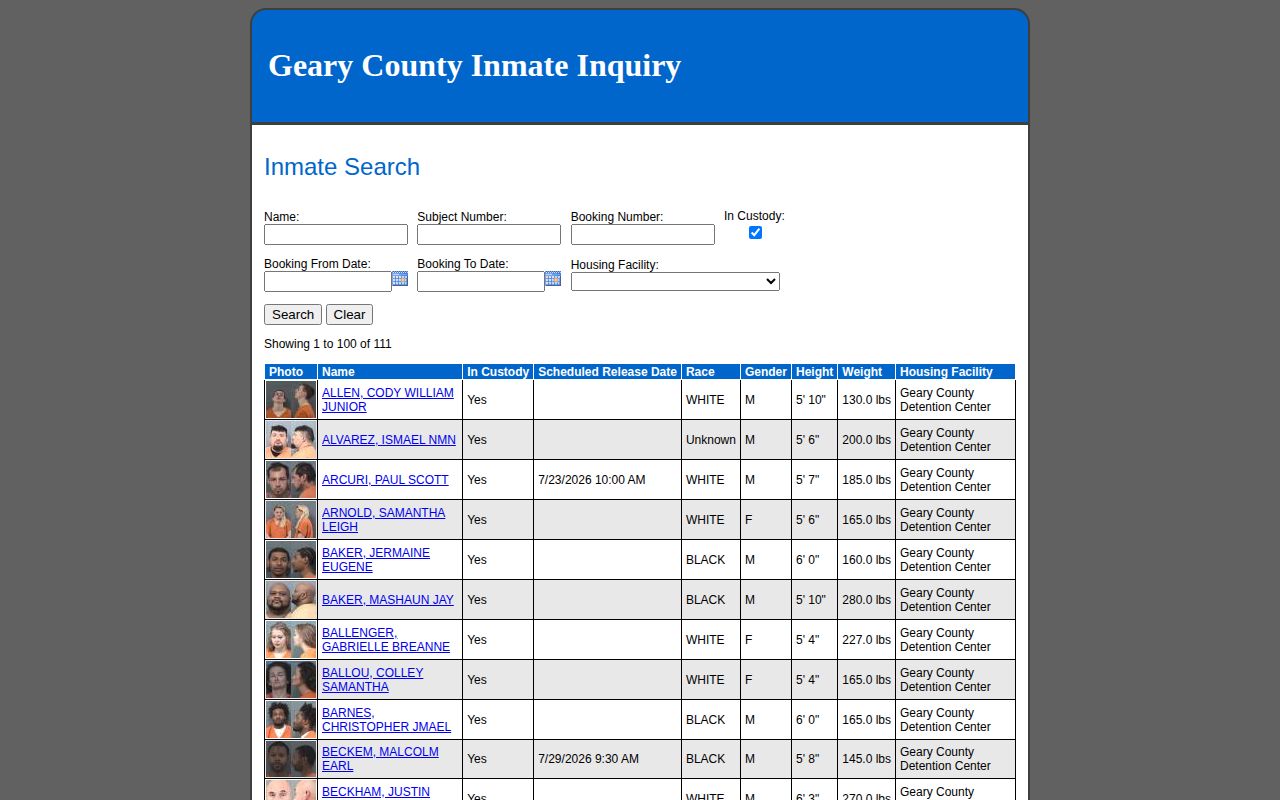
That screen supplies the first county projection, while the booking detail and court provide the later confirmation and legal context.
KASPER Geary Release Date Fields
KASPER is the Kansas Adult Supervised Population Electronic Repository. Its scope includes people incarcerated by KDOC, under post-incarceration supervision, and discharged from a sentence. Search inputs include legal name, aliases, KDOC registration number, State ID or KBI number, birth information, race, sex, conviction county, and supervision county.
The official KDOC FAQ says a public record may show convictions and case number, location and movement history with dates, custody or supervision type, parole office, discipline, and the `Anticipated release date`. An incarcerated status or named prison means KDOC still holds the person. Parole or postrelease status means prison release has occurred but supervision continues. A discharge entry means the KDOC sentence or supervision ended as described by the record.
The KDOC locating FAQ inventories the fields and populations covered by KASPER.

The field list helps separate a state anticipated date from a Geary County jail's scheduled date and from an actual exit.
KASPER information updates on working days, while the FAQ describes daily updates except weekends. A status can change before the public data catches up. Sentence-computation questions can go to KDOC at 785-296-3317. The public record should be treated as a starting point, not a promise from the Sentence Computation Unit.
Kansas Credits Change Geary Dates
K.S.A. 21-6821 permits maximum good-time credit generally equal to 15 percent of the prison portion for many offenses committed on or after July 1, 1993. This is the source of the common “85 percent” shorthand. It is not a universal rule or a guaranteed release date. Specified lower-severity categories and offense dates may receive up to 20 percent.
Eligible program completion can add up to 120 days of program credit in specified cases. Credits can be withheld or forfeited. Some sex-offense sentence credits affect postrelease exposure instead of merely shortening the whole sentence. The statute, offense date, severity, sentence type, and earned record all matter.
Older crimes and off-grid sentences follow different paths. K.S.A. 22-3725 governs good time for offenses before July 1, 1993. K.S.A. 22-3717 contains parole-eligibility rules keyed to offense and sentence date. An older indeterminate sentence may reach eligibility after the minimum less allowed credit, but mandatory minimums, life terms, excluded offenses, and later amendments can control. Eligibility only allows review. It does not guarantee parole.
Why Geary's 85 Percent Varies
The “85 percent” phrase is useful only as shorthand for the common maximum 15-percent prison credit. It becomes inaccurate when presented as a universal release rule. Some cases can use a 20-percent maximum. Certain program credits may affect the date. Forfeiture can move it later, and older or off-grid frameworks rely on other statutes.
County computation is even more distinct. No Kansas law found in the project research sets one statewide county-jail good-time percentage or a weekend early-release rule. For a Geary local sentence, use the judgment, awarded confinement credit, and jail computation. K.S.A. 19-1904 instead requires the sheriff's prisoner calendar to include the discharge date and cause. That record duty supports confirmation after release, not a shortcut for predicting it.
What Changes Geary Release Dates
A projected date is the product of facts that can change. Some changes affect the sentence calculation. Others affect whether the person can enter the community on that date. A passed date is not enough to prove release.
| Factor | Possible effect | Best source |
|---|---|---|
| Corrected jail credit | Moves the computed term after certified time changes | Sentencing journal entry and computation office |
| Concurrent or consecutive terms | Changes how multiple sentences combine | Court orders and KDOC computation |
| Good or program credit | May move the projection earlier within the governing rule | KDOC sentence record |
| Credit forfeiture | May move the projection later after discipline | KDOC disciplinary and computation record |
| New court order or appeal | Can alter the sentence or custody authority | Court docket and journal entry |
| Detainer or another sentence | Can cause transfer instead of community release | Custodian movement record and receiving agency |
| Parole Board action | Affects eligible older or indeterminate cases | Board decision and later KASPER status |
| Data correction | Changes a public field without a new court event | Agency record custodian |
A hold is a request or authority that keeps a person for another custodian. A detainer can produce a transfer on the scheduled day. Thus, the person may leave Geary jail or a KDOC prison without returning to the community.
Confirm a Geary Actual Release
For a county detainee, return to the New World booking detail after the expected date. Look for the actual release timestamp and `In Custody = No`, then check for a later booking. If destination is unclear, ask Geary Corrections at 785-762-6583 or request the existing movement and release record. The Geary County District Court can explain the underlying order.
For a state prisoner, recheck KASPER for custody, parole, postrelease, or discharge status. Use the KDOC Sentence Computation Unit when the anticipated date or credit is unclear. Kansas VINE is not the state-prison notification system. The Geary VINELink release check explains county-jail alerts and the separate KDOC notification path.
Federal prison and immigration custody require their own locators. A BOP release date proves departure from BOP, not the absence of state, local, immigration, or supervision authority. ICE ODLS has its own time and record limits. Always confirm with the custodian that produced the projected date.
When asking an office to clarify a date, provide the identifiers tied to that custodian. For Geary jail, use the full name, subject number or date of birth, booking number, and court docket when known. For KDOC, use the registration number, conviction case, and the anticipated date shown. Ask whether the date is projected, whether a hold or consecutive term affects it, and which record will show the actual event.
A narrow records question is more reliable than asking for a fresh calculation without the judgment. The court controls its order, the jail controls its local booking and movement record, and KDOC controls the state computation. Comparing those sources can reveal a stale public field, corrected credit, or a transfer that would otherwise look like community release.